
India is a nation with a long and glorious past going back all the way to the dawn of human civilization. Remains found in Narmada Valley in Central India indicate that Homo erectus (modern humans) have inhabited the area since at least the Middle Pleistocene era, somewhere between 200,000 to 500,000 years ago.
The first confirmed permanent settlements in India have been dated about 9,000 years old in the Rock Shelters of Bhimbetka in modern Madhya Pradesh, India. Evidence of farming, and herding have been found in Mehrgarh located in present day Balochistan, Pakistan making it one of the earliest sites in South Asia where farming and herding were practiced. Mehrgarh is now seen by some as a precursor to the Indus Valley Civilization.
The Indus Valley civilization flourished in the Indian Subcontinent between 3300 BC to 1300 BC and at its peak the civilization covered most of the north-western part of the subcontinent.
Amazingly the discovery of this ancient civilization by modern man was an accident. In the mid-1800's British engineers were busy constructing a railway line when they found ancient, kiln-baked bricks along the path of the track. At the time the discovery was treated as a curiosity and no attention was paid to it. It was in the 1920's that archaeologists revisited the site and determined the bricks to be over 5000 years old. Soon afterward, two important cities were discovered: Harappa on the Ravi river, and Mohenjodaro on the Indus.
Over a period of time other such cities as Dholavira, Kalibangan, Rupar, Rakhigarhi, Lothal were discovered in what is now modern day India along with Harappa, Ganeriwala, Mohenjo-daro in modern day Pakistan.
The Indus valley civilization was basically an urban civilization and the people lived in well-planned and well-built towns, which were also the centers for trade. The cities of Harappa and Mohenjo-dara show evidence of the world's first urban sanitation system. House in the city obtained their drinking water from wells and waste water was directed to covered drains. The advanced architecture of the Harappans is shown by their impressive dockyards, granaries, warehouses, brick platforms and protective walls. Some of the villages in the region still appear to follow the same construction designs for houses as the ancient Harappans.
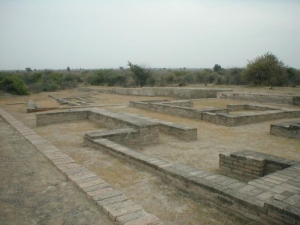
View of the street layout of Lothal
The backbone of the Indus valley Civilization was agriculture. The main food crops were Barley and wheat. Other items in their diet included cereals, vegetables and fruits, fish, fowl, mutton, beef and pork. They also domesticated various animals like the cat, dog, goat, sheep and the cow.
The people of the Indus Civilization achieved great accuracy in measuring length, mass, and time and were among the first to develop a system of uniform weights and measures. The measurements used then are said to be extremely precise. For example the smallest division of length in use in a bronze age civilization was 1.704mm. This measurement was marked on an ivory scale found in Lothal. The Harappan engineers followed the decimal division of measurement and according to a study of remains found in a Neolithic graveyard in Mehrgarh, Pakistan the people of the Indus Valley Civilization had knowledge of dentistry.
Harappan Religion
The large number of figurines found in the Indus valley suggest that the Harappan people worshiped a Mother goddess. But elements of religions that later evolved into Hinduism have been found in the ruins, these include seals showing the Swastika and symbols resembling the Siva lingam. In the early phases of the civilization the Harappans appear to have buried their dead in the early but in the later years they switched to cremation and buried the ashes instead.
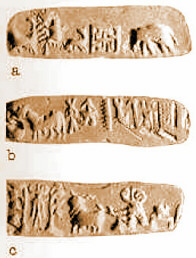
Tablets found in the Indus Valley
Decline of the Harappan Civilization
Around 1800 BCE, signs of a gradual decline began to emerge, and by around 1700 BCE, most of the cities were abandoned. A lot of theories have been put forward to explain this decline but none have been proved so far. Among various causes ascribed to the decay of Indus Valley Civilization are the invasion by the Aryans, the recurrent floods and other natural causes like earthquake, etc.
The Vedic civilization is named after the Vedas, the early literature of the Hindu people. It began with the invasion of Aryan nomads in 1500BC through the fabled Khyber pass. The origin of Aryans are disputed, one stream of thought insists on their origin in Central Asia whereas another stream of thought says that they were already living in India since the times before Indus Valley civilization as evidenced by some of the writings in Rig Veda. The Vedic period lasted from about 1500 BC to 500 BC and laid the foundations of Hinduism and many other cultural aspects of early Indian society.
The word Aryans is derived from the Sanskrit word 'arya' which means noble. They were a race of nomads who migrated from the Northwest to the area called Sapta-Sindhava (the land of the seven rivers) - Eastern Afghanistan, Punjab and the fringes of western Uttar Pradesh. Here they mingled with the local tribes and assimilated themselves into their social framework.
From the original Aryan settlements in the Punjab region the Aryans gradually penetrated eastward by clearing the dense forests and established settlements along the Ganga and Yamuna rivers. By around 500 B.C., most of northern India was inhabited and had been brought under cultivation, facilitating the increasing knowledge of the use of iron implements, including ox-drawn plows. During this time sixteen monarchies and republics known as Mahajanapads - Kasi, Kosala, Anga, Magadha, Vajji (or Vriji), Malla, Chedi, Vatsa (or Vamsa), Kuru, Panchala, Machcha (or Matsya), Surasena, Assaka, Avanti, Gandhara and Kamboja were formed. These republics were ruled by kings and the right of a king to the throne was usually legitimized through elaborate sacrifice rituals and genealogies concocted by priests who ascribed to the king divine or superhuman origins.
The epic Ramayana celebrating the victory of good over evil was composed during this period along with the Mahabharata which spells out the concept of dharma and duty. The epics were composed in Sanskrit as it was the main language of the educated masses in the 'republics' while the general population spoke dialects known as Prakrits.
Vedic Religion
The Vedic religious beliefs are the precursor to modern Hinduism. The rituals during this time centered on a priestly class performing rites to apease the Gods. Its liturgy is reflected in the Mantra portion of the four Vedas.
The main deities of the Vedic pantheon were Indra, Agni (the sacrificial fire), and Soma and some deities of social order such as Mitra-Varuna, Aryaman, Bhaga and Amsa, further nature deities such as Surya (the Sun), Vayu (the wind), Prithivi (the earth). Goddesses included Ushas (the dawn), Prithvi and Aditi (the mother of the Aditya gods or sometimes the cow). Rivers, especially Saraswati, were also considered goddesses.
The Deities in the Aryan religion were not all-powerful and the relationship between deities and humans was one of transaction. Agni acted as a messenger between the humans and the deities so all prayers to gods involved making an offering to fire in ceremonies known as Yagnas.
It is during this period that the Upanishads are believed to have been composed. They had a significant effect on the Indian philosophy and were contemporary to the development of Buddhism and Jainism.
Text from the Veda
It is believed that in 537 BCE, that Siddhartha Gautama attained the state of "enlightenment", and became known as the 'Buddha' - the elightened one. Around the same time, Mahavira (the 24th Jain Tirthankara according to Jains) propagated a similar theology, that was to later become Jainism.
In early 520BC the Persian invasions on India started and most of the northwestern Indian Subcontinent came under the rule of the Persian Achaemenid Empire. The Persian rule continued without many issues for another two centuries after that.
In 326 Alexander the Great reached the north-west frontier of India after conquering Asia Minor and the Achaemenid Empire. Here he conqured most of Punjab by defeating King Puru. Alexander's march East put him in confrontation with the Nanda Empire of Magadha and Gangaridai Empire of Bengal. His army, exhausted and frightened by the prospect of facing larger Indian armies at the Ganges River, mutinied at the Hyphasis (modern Beas) and refused to march further East. Alexander, after the meeting with his officer, Coenus, was convinced that it was better to return.
Even though the Nanda empire never had to meet the Greek army in battle it only lasted about 100 years. The last Nanda king, Dhana Nanda was overthrown by Chandragupta Maurya who founded the Maurya Empire.
The Mauryan dynasty founded by Chandragupta Maurya was the first historical dynasty in India. Originating from the kingdom of Magadha in the Indo-Gangetic plains (modern Bihar, eastern Uttar Pradesh and Bengal) in the eastern side of the Indian subcontinent, the empire had its capital city at Pataliputra (near modern Patna).
At its greatest extent, the Empire stretched to the north along the natural boundaries of the Himalayas, and to the east stretching into what is now Assam. To the west, it reached beyond modern Pakistan, annexing Balochistan and much of what is now Afghanistan, including the modern Herat and Kandahar provinces.
The Mauryan Empire was one of the largest empire to rule the Indian subcontinent. About fifty years after Ashoka's rule ended the empire declined and became fragmented with the various parts becoming independent kingdoms. This continued for the next ten centuries after which the northern regions were united under the Gupta Empire by the 2-4th Century CE
The Gupta empire was founded in 2th Century CE by Sri-Gupta. The empire was well known for it military strength and at its peak it covered most of northern and central India, as well as parts of modern-day Pakistan and Bangladesh.
The Gupta Empire is considered by many scholars to be the "classical age" of Hindu and Buddhist art and literature. The Rulers of the Empire were strong supporters of developments in the arts, architecture, science, and literature. Scholars of this period include Aryabhatta, who is believed to be the first to come up with the concept of zero, postulated the theory that the Earth moves round the Sun, and studied solar and lunar eclipses. Kalidasa, who was a great playwright, who wrote plays such as Shakuntala, (said to have inspired Goethe) is also said to have belonged to this period.
The attacks of the Hunas along with weak kings in succession weakend the empire and it finally ended with the rule of King Vishnugupta who reigned from 540 to 550.
Although Arab traders had been visiting the western coast of India since 712 CE the actual invasions by the Muslim world didn't start till 1001 when Mahmud of Ghazi attacked India for 26 years in succession. Each year they would attack and loot the cities of their riches and then return to their homeland only to repeat the cycle next year. This made subsequent invasions of the country easier.
During the last quarter of the twelfth century, Muhammad of Ghor invaded the country and within four years he had conquered the most powerful Hindu kingdoms along the Ganges. When Ghor died in 1206, one of his generals Qutb-ud-din Aybak proclaimed himself Sultan of Delhi and founded the Mamluk Dynasty or Ghulam Dynasty. He established his capital first at Lahore, and later at Delhi, where he started building the Qutb complex that houses the Qutab Minar which is the tallest brick minaret in the world along with the Iron pillar which is almost seven meters (22 feet) high and weighs more than six tons and is almost 98% pure iron.
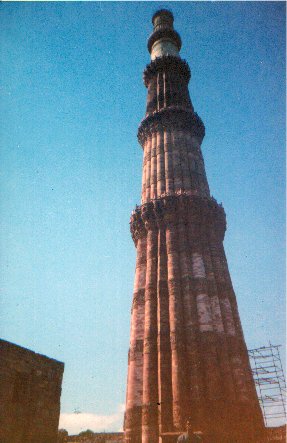
The Qutab Minar
It was in this dynasty the first female ruler from the Muslim world; Razia Sultana ruled for four years.
The Mamluk dynasty (1206-90) along with the Khilji dynasty (1290-1320), the Tughlaq dynasty (1320-1413), the Sayyid dynasty (1414-51), and the Lodhi dynasty (1451-1526) are collectively known as the Delhi Sultanate. In 1526 the Delhi Sultanate was absorbed by the emerging Mughal Empire.
The Mughal Empire was founded in the early 1500s by the Timurid prince Babur, who defeated the last of the Delhi Sultans, Ibrahim Shah Lodi, at the First Battle of Panipat. His son Humayun succeeded him in 1530 but he turned out to be a weak ruler and most of the territories won by Babur revolted under his rule. At the time of his death he had reconquered the central plateau around Delhi but most of the region was still unsettled and in revolt.
Humayun's son Akbar succeeded his father at the tender age of 14 and took the Mughal Empire to a peak. He initiated several important policies, such as religious liberalism, inclusion of Hindus in the affairs of the empire, and political alliance/marriage with the Hindu Rajput caste which served to maintain the power and stability of the empire. These policies were maintained by his two immediate successors, Jahangir and Shah Jahan.
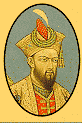
|
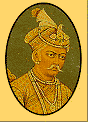
|
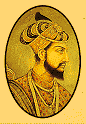
|
|
Babur |
Akbar |
Shajahan |
By the time Shah Jahan succeeded to the throne this was perhaps the greatest empire in the world and had attained a peak of tolerance, harmony and a spirit of inquiry. Shah Jahan erected many splendid monuments during his rule. He commissioned the famous Taj Mahal to be built as a tomb for his wife Mumtaz Mahal. He had the Delhi Fort (also known as the Red Fort or Lal Quila) and the Jama Masjid constructed in Delhi along with large sections of Agra Fort in Agra. He also had the Peacock Throne, made to celebrate his rule.
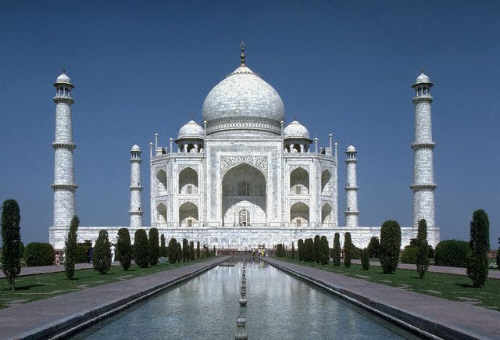
The Taj Mahal
Shah Jahan's son Aurangzeb inherited the throne in 1659 by defeating his brothers. Aurangzeb discarded Akbar's policies of religious tolerance and initiated laws which interfered with non-Muslim worship. These included the destruction of Hindu temples. His rule significantly favored Muslims over non-Muslims and he actively encouraged non-muslims to convert to Islam.
Aurangzeb spent nearly his entire career seeking to expand his realm into the Deccan and south India which sapped the resources of the empire and the empire fell into decline. Over a period of time following his rule the Mughal Emperors progressively declined in power and slowly became figureheads. In 1803, the blind Shah Alam II formally accepted the protection of the British East India Company and his descendant Bahadur Shah Zafar who was the last Mughal Emperor was deposed in 1857 by the East India Company which ended the Mughal Empire.
In the late 1400's the Europeans came to India for trade and the Portuguese were the first Europeans to land in India for trade purposes. The first Portuguese ship landed in Calcutta under the command of Vasco da Gama in 1498. The French and the British soon followed them. On 31st Dec 1600 AD Queen Elizabeth I granted the East India company a charter giving them monopoly over the Indian trade.
Soon afterwards the company turned its interest from trading and started conquering the Indian states. Due to the superior firepower and armies the company soon controlled a major portion of India. They used other methods like the Doctrine of Lapse to further gain control of more Indian states. According to this doctrine if a ruler of a state died without an heir the state was annexed to the British Empire, this along with other cruel management policies of the Company lead to the great mutiny of 1857.
After a century of mismanagement by the British the Indians were so restless that only a spark was needed to start a revolt. The greased cartridge episode provided this spark. A rumor spread among the troops that the new cartridge being issued to them was greased with the fat of cow and pigs. As the troops had to bite the bullet before firing there was much protest because eating beef and pork was against the religion of most of the soilders. But the company failed to respond to these and soon the soldiers stationed at Meerut mutinied. They marched to Delhi and proclaimed Bahadur Shah Zafar as the Emperor of India.
The mutiny failed but because of it the Company rule ended in India and the British government took control over India. The queen promised that no more of the Princely states would be annexed to the empire and made several other changes in the method of ruling. Inspite of these changes the spirit of resistance prevailed and many mutinies broke out but these were soon contained.
The devastating famines between 1866 and 1906 and the cruelty shown by the British government during their rule soon shattered the dreams of the national leaders. They formed various national parties and were soon demanding the freedom of India from the British. Initially the leaders demanded freedom using nonviolent methods but when they saw that the government was indifferent to their demands several of them turned towards violence to make themselves heard. This class of freedom fighters was called the extremists and prominent leaders were Lala Lajpat Rai, Lokmanya Bal Gangadhar Tilak and Bipin Chandra Pal. Together the trio was known as Lal-Bal-Pal and their activities were a source of alarm to the British. Tilak raised the famous slogan "Swaraj is my birthright and I shall have it"
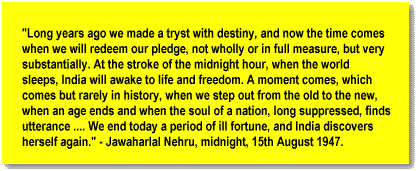
After many years of fighting and suffering India finally won her independence from the British. On 15th Aug 1947 India became an Independent country but the British divided India into two countries: India and Pakistan. Inspite of the division India soon started on the path of development and today is one of the worlds major powers with peaceful relations with most of the other countries.

Home | About Me | About India |Hotlinks | Linux Related |
Mirror | Misc Section | My Blog | Photogallery | Scripts | Tech Section | Contact Me